
Seneca Village: History and Archaeological Context

Transect 3: The Teapot's Find Site
This area corresponds approximately to Transect 3 of the archaeological site, where the teapot was found.
The star on the image below, indicates its rough position in the transect.
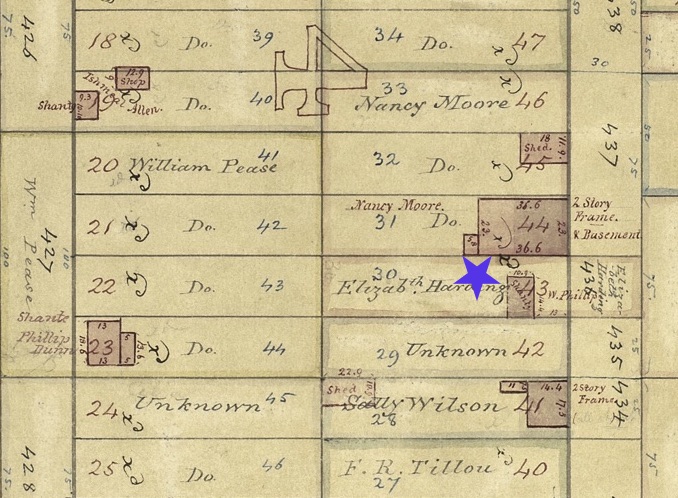
Seneca Village History and Excavation
In order to fully understand the Staffordshire teapot, we need to understand the site that it came from. Seneca Village was a community composed primarily of African American landowners, and was located in what is present day Central Park. Its borders corresponded approximately with 83nd and 88th Streets, and where 7th and 8th Avenues would have been. 1 Though tracts of land had already been in use around the area of what became known as Seneca Village, the real sprouting to the community came in 1825, when a cartman named John Whitehead began selling tracts of his farmland located in the area. Multiple individuals as well as the African Methodist Episcopal Zion Church purchased a number of these tracts, and by 1829 at least nine houses were located in the area, while by 1833 at least 24 parcels of land were owned by black individuals.2 Over the ensuing years, more and more black families came to own land and build houses in the area. The height of the neighborhood came in 1855, when there were over 260 residents. These residents were primarily African American, however the village also began to see greater levels of intermingling, with 30% of the community being of Irish descent by 1855.3
Though the community faced discrimination, evidence supports the hypothesis that the community was actually quite stable and prosperous, with high levels of interpersonal connection. Some families had decades long connections with the area, and strong relationship bonds, intermarriages, and kinship ties made for a strong community.4 Seneca village had multiple churches, cemeteries, and a school, all of which contributed significantly to the stability and sense of community in the village. Churches were a strong source of spiritual and social nourishment, while nearly 75% of Seneca Village’s children attended school, meaning the community was investing strongly in education.5 Additionally, some families owned multiple property holdings, and black land ownership of Seneca Village residents was five times higher than their counterparts in wider New York City.6 This was highly significant, as property ownership opened the door to suffrage for black men, who faced a $250 property requirement in order to vote.7 Despite this, the residents lacked security of tenure, and once plans to create Central Park had been finalized in the 1850s, the entire community was evicted under the auspices of eminent domain.8
The Teapot in Its Archaeological Context
Once construction of the park was underway, the remnants of Seneca Village were destroyed. After this time, memory of Seneca Village was largely lost, despite the significance of the settlement. It was not until the early 2000s that researchers began looking into the history of Seneca village more deeply, and archaeological digs were carried out. It was during the excavation of 2011 that the teapot was recovered.9 During the excavation and research process, historic documents were used in order to gain more information about the site and the objects being recovered, and as well, in order to situate the archaeological site within its historical context. Historical documents included, but were not limited to, maps, census reports, and church documents. The Sage Central Park condemnation map of 1856, is a particularly useful resource, and can be used alongside the New York census report of 1855 to imagine the social landscape of the neighborhood. As well as providing information about the historical Seneca Village landscape, these documents also provide necessary information about the people who lived in the village. With the combined tools of the research data and historical documents, we can situate the teapot within its archaeological context. The teapot was found in Transect 3 of the archaeological landscape, which corresponds roughly to the original locations of the house owned by Nancy Moore, and later the Webster family, and the Phillips house.10 Knowing this helps us establish potential ownership of the teapot and how its use in Seneca Village may have been impacted by its original owner.
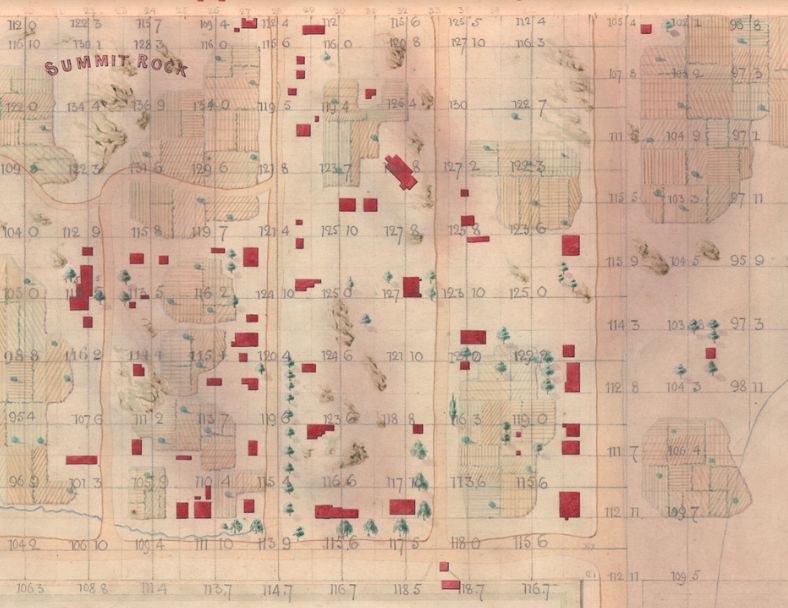
Fig. 1 The Viele Topographical Survey for the Grounds of Central Park of 1856. This map records the buildings of Seneca Village as part of the topography.11
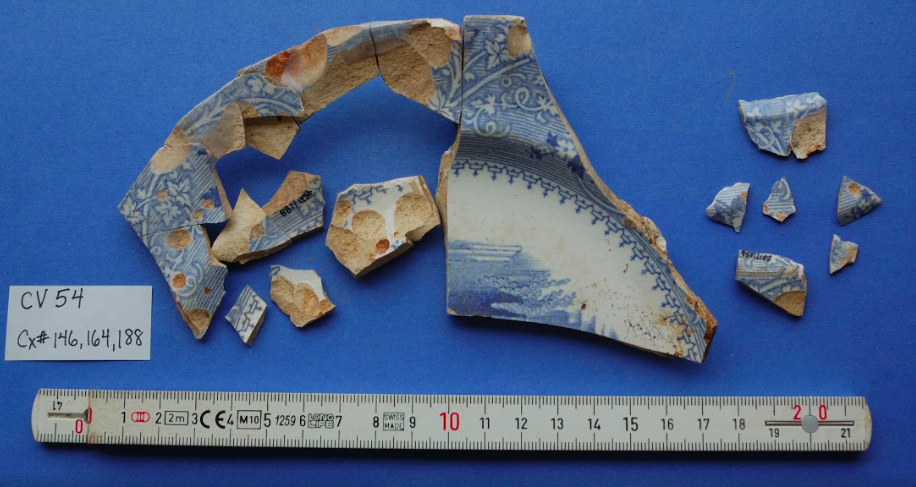
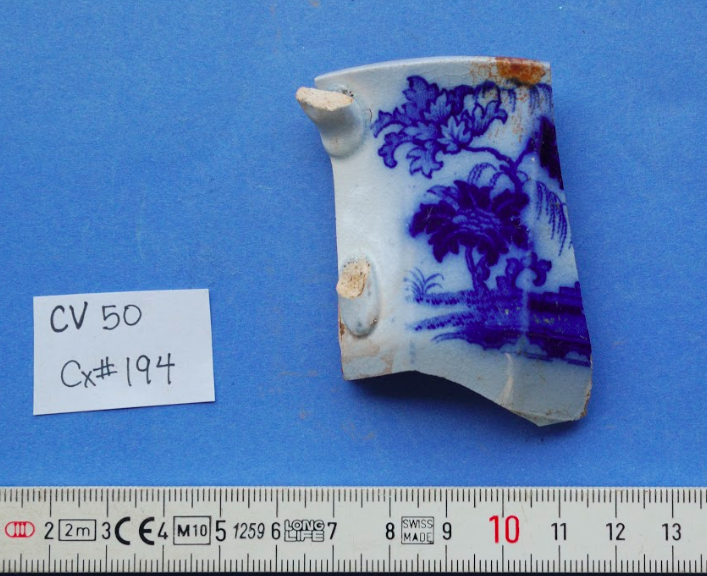
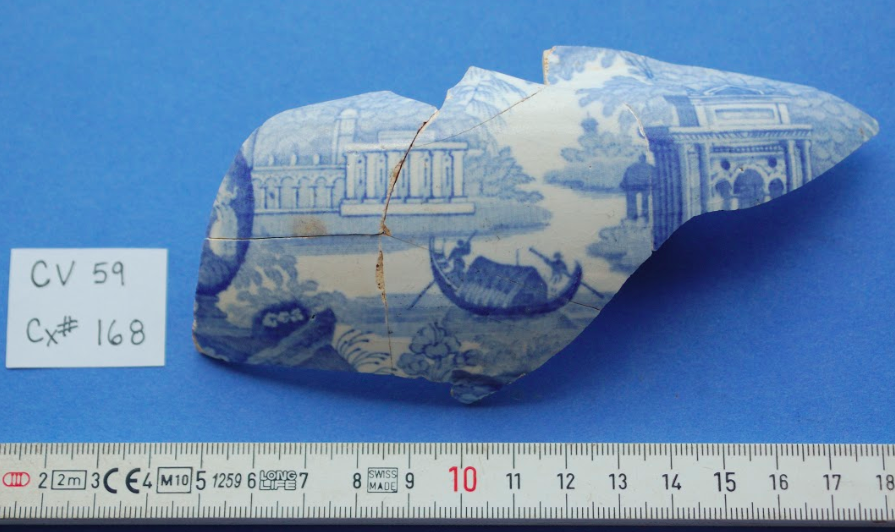
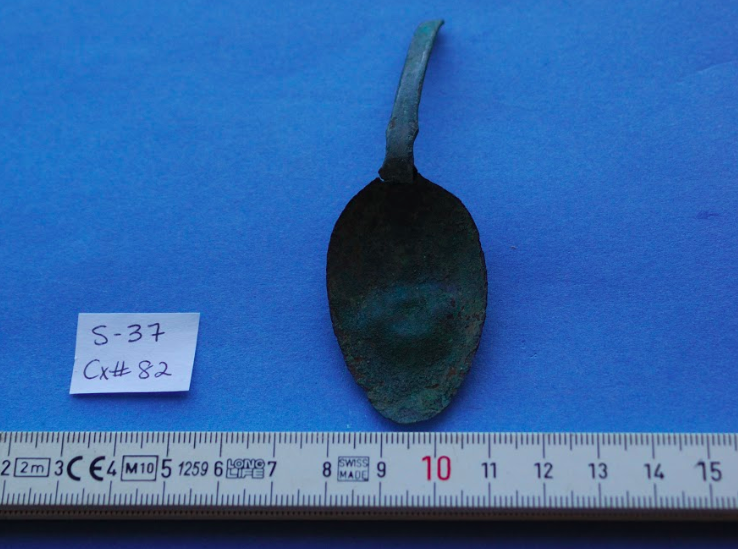
Fig. 2-5 A selection of other potential teawares from Seneca Village including transfer-printed ceramic sherds and a spoon.12
By grounding the teapot in relation to the people who lived near its find-site, we also gain a deeper picture of that part of the neighborhood, who lived in that area, and what their relationship may have been to the object. We can compare the teapot to other teawares found in the village to make hypotheses about how tea (and the materials used to consume it) were being put to use in the area. In fact, multiple pieces of ephemera related to tea drinking were found throughout Seneca Village, including a multitude of whole or partial teacups, saucers,13 and spoons.14 These materials were found not only near the teapot at Transect 3, but all over the village as well, including at the site of the Wilson House, All Angels’ Church, and Transect 4. Additionally, many of these ceramics were decorated through transfer-printing, as is the teapot. Interestingly, while most of the transfer-printed wares were printed with blue decoration, a few were printed with brown instead.15 This may highlight potential taste differences and individuality among the Seneca Villagers, even if they were subscribing to a similar ceramic trend. Knowing that material culture similar to the teapot was found in many sites in Seneca Village gives us a more accurate picture of how the teapot functioned in its original context and the meaning it had for its owners. We can thus begin to explore the culture of tea drinking in Seneca Village, and how it was practiced by the people who lived there. To do this, we must look closely at the members of the community who may have interacted with these objects.
To find out more about the specific people who lived in Seneca Village, head over to the Women in Seneca Village page!
- Roy Rosenzweig and Elizabeth Blackmar, The Park and the People: A History of Central Park, (Ithaca, NY: Cornell University Press, 1992), 65.
- Ibid. 65
- Ibid. 66
- Ibid. 67-68
- Diana di Zerega Wall, Nan A. Rothschild, and Cynthia Copeland, “Seneca Village and Little Africa: Two African American Communities in Antebellum New York City,” Historical Archaeology 42, no. 1 (2008): 101.
- Rosenzweig and Blackmar, The Park and the People: A History of Central Park, 70.
- Ibid. 72.
- Wall, Rothschild, and Copeland, “Seneca Village and Little Africa: Two African American Communities in Antebellum New York City,” 98.
- Diana di Zerega Wall, Nan A. Rothschild, Meredith B. Linn, and Cynthia R. Copeland, “Seneca Village, a Forgotten Community: Report on the 2011 Excavations,” Institute for the Exploration of Seneca Village History, (Submitted to the NYC Landmarks Preservation Commission, the Central Park Conservancy, and the NYC Department of Parks and Recreation, 2018)
- Ibid. 67
- Egbert L. Viele, Topographical Survey for the Grounds of Central Park, The New-York Historical Society, NY., 1856
- Transfer-printed Ceramics and Teawares, CV 54, CV 50, CV 59, S-37, Reported in Diana di Zerega Wall, Nan A. Rothschild, Meredith B. Linn, and Cynthia R. Copeland, “Seneca Village, a Forgotten Community: Report on the 2011 Excavations,” Institute for the Exploration of Seneca Village History (Submitted to the NYC Landmarks Preservation Commission, the Central Park Conservancy, and the NYC Department of Parks and Recreation, 2018). http://s-media.nyc.gov/agencies/lpc/arch_reports/1828.pdf.
- Ibid. Appendix B-16
- Ibid. Appendix B-18, Appendix B-19
- Ibid. Appendix B-16