
The Women of Seneca Village
In order to explore the culture of tea drinking in Seneca Village, we may center our discussion by looking at Seneca Villagers who most likely had the closest relationship with the teapot. We will also specifically be looking at the women in this portion of Seneca Village, who, as we have established, had a particularly complex relationship to tea in comparison with their male counterparts. (See the Teapot page, and the Teapot as Mediator page to explore further). To do this, we compare the New York census report of 1855 with the Sage Condemnation Map of 1856, linking specific names to the site where the teapot was found. (To find out more about the archaeology of Seneca Village check out the Seneca Village page). A few specific names can be identified in relation to the teapot’s location, specifically that of Nancy Moore, the Webster family, Phillips family, Dunn family, Elizabeth Harding, and Sally Wilson. Heirs to a woman named Diana Harding (who was presumably a relative of Elizabeth Harding) are also listed owning a tract of land nearby. Both Elizabeth Harding and Sally Wilson are listed as the land owners on the 1856 Sage Condemnation Map but were presumably not residents, at least on this particular land tract. The others however, are listed as residents. The teapot was found on the plot of land owned by Elizabeth Harding, where the Phillips family (consisting of William and his 19 year old wife Matilda) are listed as having a ‘shanty.’1 The tract of land next door, to the west, was owned by Nancy Webster. This plot also had a house, the residence of Nancy Moore, a residence which was later occupied by the Webster family.2 The Webster family was large, and included George Webster and his wife Eliza, their son George Jr., and Elizabeth’s children from a previous relationship, Malvina, John, Benjamin, and Edward Hall.3 To the east, a tract of land containing a house was owned by Sally Wilson, though it is unclear who the resident of the house was.4 To the south, another plot of land containing a ‘shany’ was the residence of the Dunn family, consisting of husband Phillip and wife Mary. The Dunns were an Irish family, in contrast to their African American neighbors.5
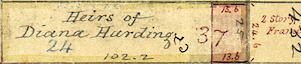
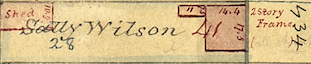
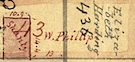
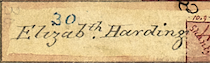
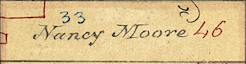
Fig. 1-5 Close up images from the Sage Map of 1856, listing the names and residences of those who lived near the teapot’s find-site. Nancy Moore, Sally Wilson, the Phillips family, Elizabeth Harding, and Diana Harding’s Heirs are all named on the map.6
Neighborhood Relationships and Agency
Using this data, we can begin to construct ideas of what neighborly relationships may have been like in this part of the village, and what these women’s relationships may have been to each other and others in the village. Here, census records again prove fruitful; we can use these documents to discern more about the lives of these women. Literacy, for example, is recorded in the census, and thus we know that both Malvina Hall and Mary Dunn could read and write,7 indicating that at some point both women had had access to education (whether in school or at home), and someone to encourage their learning. The Sage Condemnation Map also gives interesting clues as to the agency of women in the village. Nancy Moore, Sally Wilson, and Elizabeth Harding are listed as owning land, something that would have given them considerable power in that they could utilize the land themselves (either to live on, or farm), or could rent it out. And, if they owned it outright (rather than in name on behalf of a male family member), it also would have given them a large degree of independence as women. As well, in utilizing the Sage map we also find that the Moore/Webster house, and the house located on Sally Wilson’s land, are listed as two story frame houses, as is the house on the land once owned by Diana Harding.8 Clearly the women who owned these spaces had invested enough into their land to develop the houses, and had access to the raw materials or financial capital to make this possible. Even those houses listed as ‘shanties’ may have been much more stable and comfortable than the demeaning name suggests. As scholars Rosenzweig and Blackmar, authors of The Park and the People, assert, the living conditions of Seneca Villagers, even in small or crowded houses, was miles above the conditions of their counterparts living downtown, and Seneca Villagers also had access to additional homespaces such as yards.9 Although, Rosenzweig and Blackmar also point out that these houses and living conditions were potentially the result of a generation’s worth of saving and work, and potentially the residents own building labor.10 Scholar Whitney Battle-Baptiste also speaks to the importance of a yard space and women’s ability to maintain the domestic environment. Battle-Baptiste discusses the archaeology of the living quarters of slaves on the Hermitage plantation, pointing out that for people in captivity, the yard space was one of socializing, play, chores, and spiritual or cultural expression. She then conveys the yard as an extension of the homespace, where women especially had some agency in defining their environment. 11 Seneca Village women were at an advantage compared to most women who lived downtown (of any race), where yard space was limited, allowing them to expand their homespace in a way many women could not. Given this definition of the yard, it is not hard to see how it may have conveyed a certain level of power in how women cultivated their entire domestic space, especially African American women who were contending with the legacy of slavery in America.
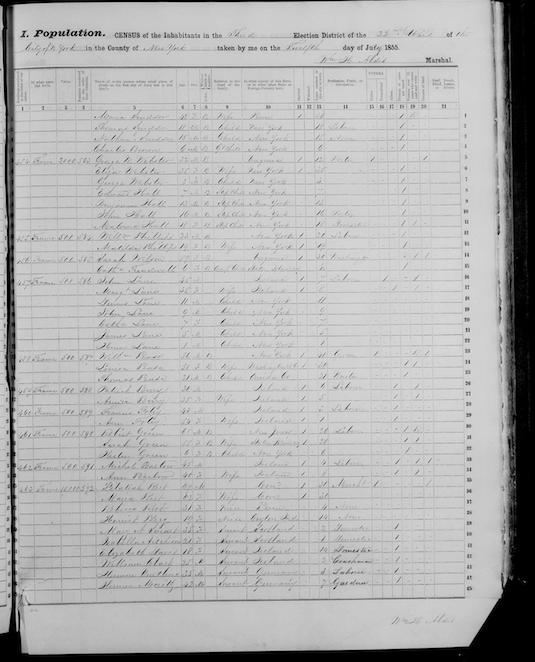
Fig. 6 A page from the 1855 New York State Census which lists the Phillips and Webster families.12
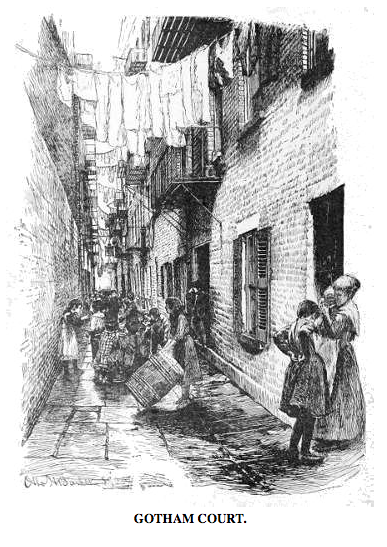
Fig. 7 An illustration from Jacob Riis’ How the Other Half Lives, showing a crowded New York tenement. Living quarters such as this would contrast greatly to a piece of land that included a yard or substantial outdoor space.13
These levels of power and agency acquired by Seneca Villagers is also highlighted through census documents which reveal occupations held by the women of this part of the neighborhood. Women often did work to supplement the income of their male counterparts, either through the housework they completed, or by obtaining jobs as domestic servants or laundresses.14 Black women also actively sought jobs that would give them greater autonomy in their place of work over those that didn’t, suggesting they had at least some level of agency in their bodies and labor.15 Malvina Hall, of the Webster family, is listed as a domestic laborer,16 for example, though she also presumably would have helped her mother, Eliza, with housework and caring for the four other children in the house, including George Jr. who was only 3 years old at the time of the census.17 Even women who are not listed as having occupations in the census would have performed a significant amount of labour and contributed to the economics of the home in how they cooked, mended clothes, completed housework, and consumed goods. 18 We can also imagine how these women, as neighbors, may have helped one another with domestic work or childcare, and how kinship would arise through these experiences. It could be possible for example, that Matilda Phillips, who is not listed as having a formal occupation, may have assisted Eliza Webster, who lived only a few doors down, in looking after her children, especially since Eliza’s eldest daughter Malvina was employed elsewhere. Meanwhile, Eliza, as a mother with a daughter close to Matilda’s age (19 years old), may have taken on a mentorship role toward Matilda. And, as Eliza too, is not listed as having an outside occupation, it could be possible that the two women assisted one another with housework. While constructing an image of the interpersonal relationships of the neighborhood we can consider further historical documents, including church records. Of the three churches in Seneca Village, the All Angels’ Church kept records of both marriages and baptisms. Although the women who lived near the teapot’s find-site are primarily not recorded in these documents (aside from Mary Dunn, who is listed as a witness to the marriage of James Cassidy and Mary O’Neil in 1849),19 these documents still speak to the complex web of interconnection, especially between women, in Seneca Village. Women act both as baptismal sponsors and marriage witnesses for one another, speaking to their familiarity with each other, and the reciprocity among the women in the village.
To discover the ways these relationships may have been bolstered by the practice of tea drinking, check out the Teapot as Mediator page.
- Gardner A. Sage, Central Park Condemnation Map, Municipal Archives, New York, NY., 1856.
- Diana di Zerega Wall, Nan A. Rothschild, Meredith B. Linn, and Cynthia R. Copeland, “Seneca Village, a Forgotten Community: Report on the 2011 Excavations,” Institute for the Exploration of Seneca Village History, (Submitted to the NYC Landmarks Preservation Commission, the Central Park Conservancy, and the NYC Department of Parks and Recreation, 2018), 67.
- New York State [NYSC], Census of the State of New York, County of New York. Research Division, New York Public Library, NY., 1855.
- Sage, Central Park Condemnation Map, 1856
- New York State, Census of the State of New York, 1855.
- Sage, Central Park Condemnation Map, 1856.
- Ibid.
- Sage, Central Park Condemnation Map, 1856.
- Roy Rosenzweig and Elizabeth Blackmar, The Park and the People: A History of Central Park (Ithaca, NY: Cornell University Press, 1992), 68.
- Ibid. 68-69.
- Whitney Battle-Baptiste, Black Feminist Archaeology (Walnut Creek, Calif.: Left Coast Press, 2011), 96.9
- New York State, Census of the State of New York, 1855.
- Jacob Riis, “Gotham Court,” Illustration from Jacob Riis, How the Other Half Lives, New York: Charles Scribner’s Sons, 1890.
- Rozenzweig and Blackmar, The Park and the People: A History of Central Park, 69.
- Leslie M. Harris, In the Shadow of Slavery: African Americans In New York City, 1626-1863, (Chicago, Ill.: University of Chicago Press, 2004), 81.
- New York State, Census of the State of New York, 1855.
- Ibid.
- Rozenzweig and Blackmar, The Park and the People: A History of Central Park, 69.
- All Angels’ Church, “Marriage Records,” New York City, New York, All Angels’ Church, 1849-1856.